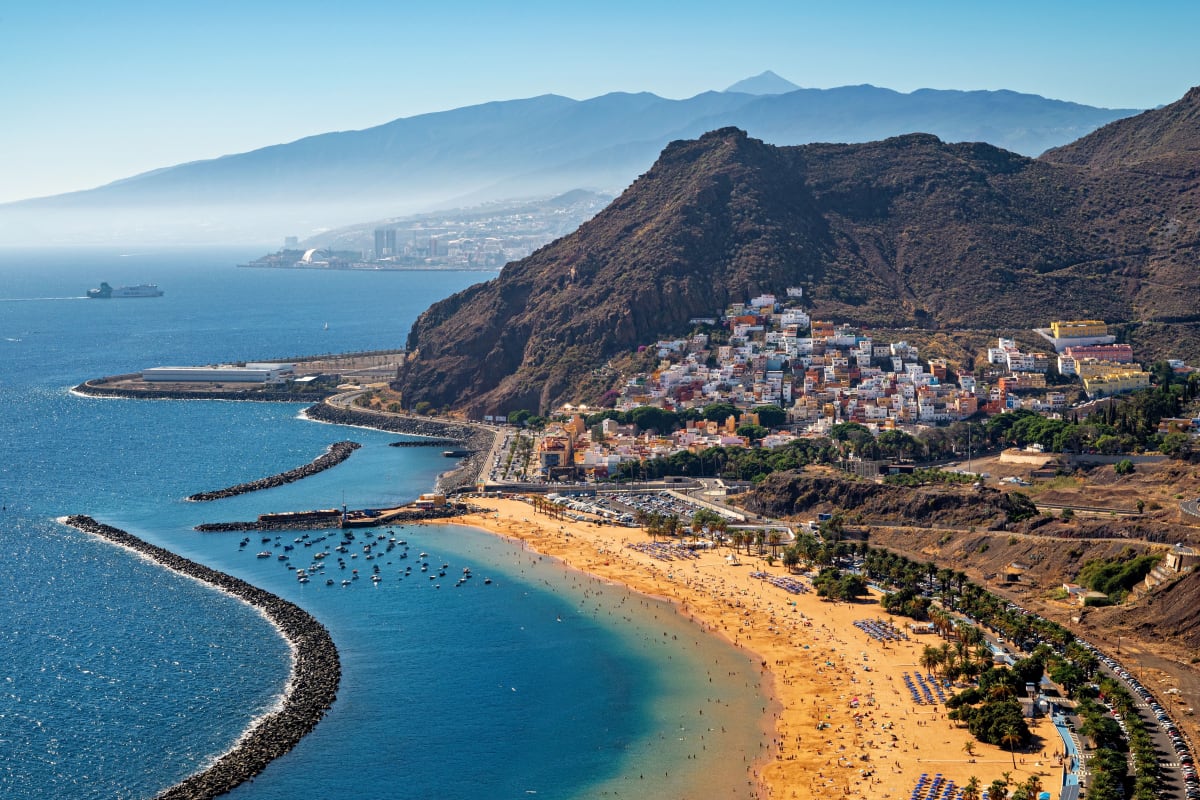
The water between Tenerife and La Gomera holds a resident population of short-finned pilot whales, several hundred of them, present every month of the year. They are there because the sea floor drops away steeply within a few miles of the coast and the channel funnels deep water past the island. Bottlenose dolphins are resident too. Between them they make this one of the most reliable places in Europe to see cetaceans from a boat, and the only one where you can do it in February wearing a t-shirt.
That reliability has produced a very large number of operators, and the gap between the best and the worst of them is wide.
The Blue Boat flag is the shortcut
The Canary Islands government runs a certification called Barco Azul, the Blue Boat. A vessel carrying the flag has agreed to a set of rules on how close it may go, how fast it may move near animals, how long it may stay, and how many boats may be present at once.
It is not a guarantee of a good trip and it is not a marketing badge the operator awarded itself. It is a licence condition with an inspection behind it, and it is the single most useful thing to look for.
Operators who hold it say so prominently. Operators who do not tend to talk about sighting rates instead.
What "no chase" actually means
The phrase turns up in a lot of listings. The behaviour it describes is specific: the boat positions itself in the animals' path and cuts its engine, and then waits. If the pod moves away, the trip moves on rather than following.
The alternative, which you will see happening from the deck of a good boat, is a vessel tracking a pod at speed to keep it alongside for the passengers. That separates mothers from calves and it disrupts feeding, and the animals learn to leave the area.
You can tell which sort you are on within twenty minutes of the first sighting.
Tours and Things to Do in Tenerife
Whale watching, Teide, boat trips, walking tours and day trips across the island and out to La Gomera, via GetYourGuide.
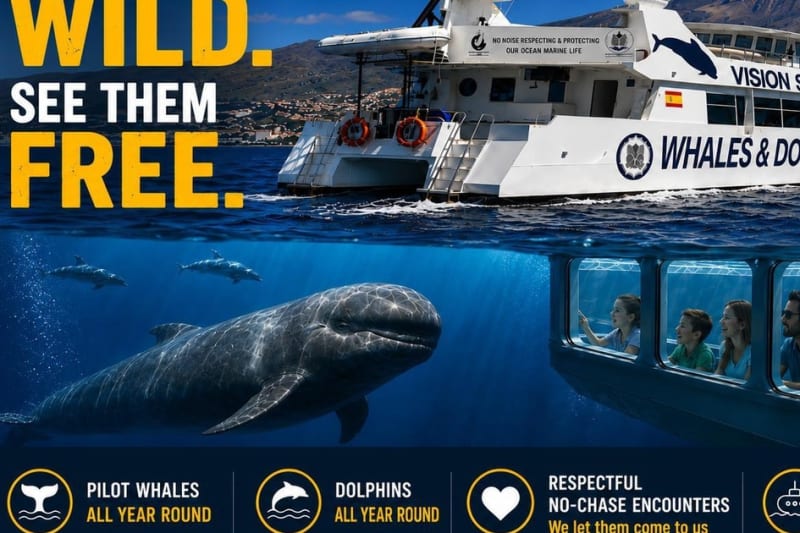
Whale and dolphin cruise that does not chase
Pilot whales and dolphins watched without the boat pursuing them, which is the version worth paying for.
Check availability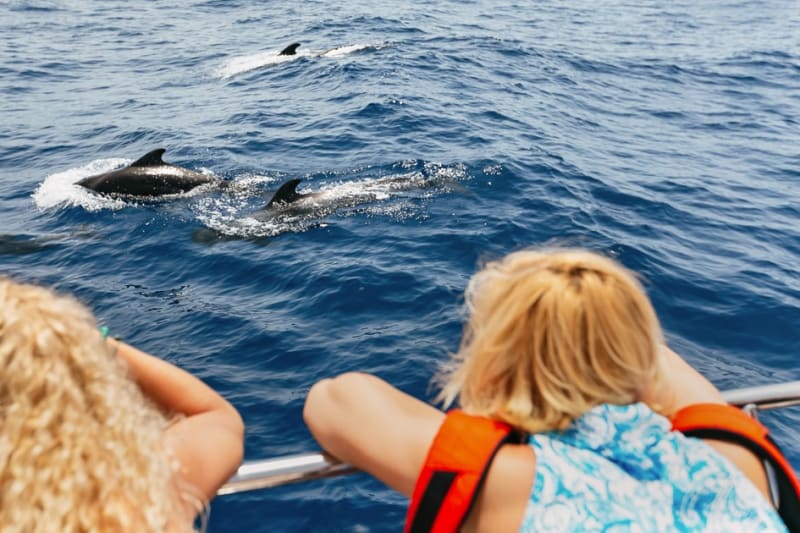
Costa Adeje whale watching catamaran
Two hours out of Costa Adeje looking for the resident pilot whales, with a drink included.
Check availability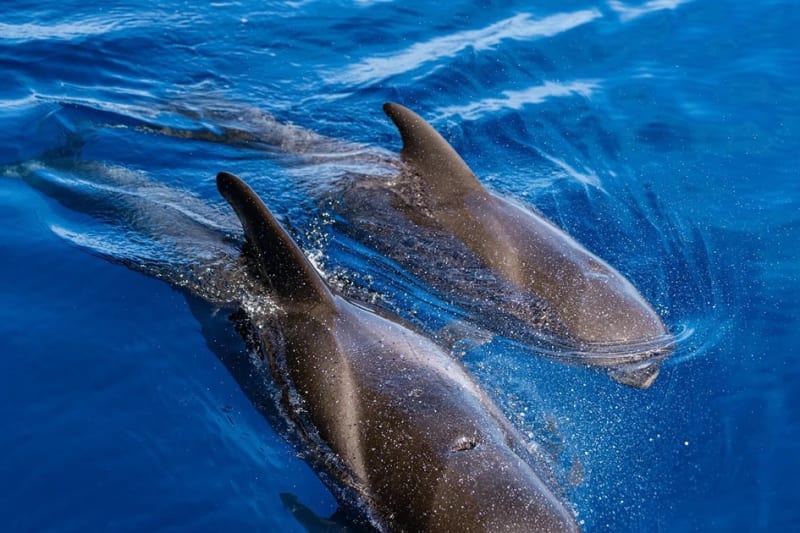
Masca and Los Gigantes by whale watching cruise
The cliffs and the mouth of the Masca ravine from the water, watching for whales on the way out.
Check availabilityWhere the boats leave from
Three harbours do almost all of it, and which you pick changes the trip.
Los Cristianos is the biggest port on the south coast and has the widest choice, from two-hour trips to full days. It is also the busiest.
Puerto Colón, at Costa Adeje, is a marina rather than a working port and is where most of the catamarans are based. Trips from here lean towards the comfortable end: shade, a buffet, a swim stop.
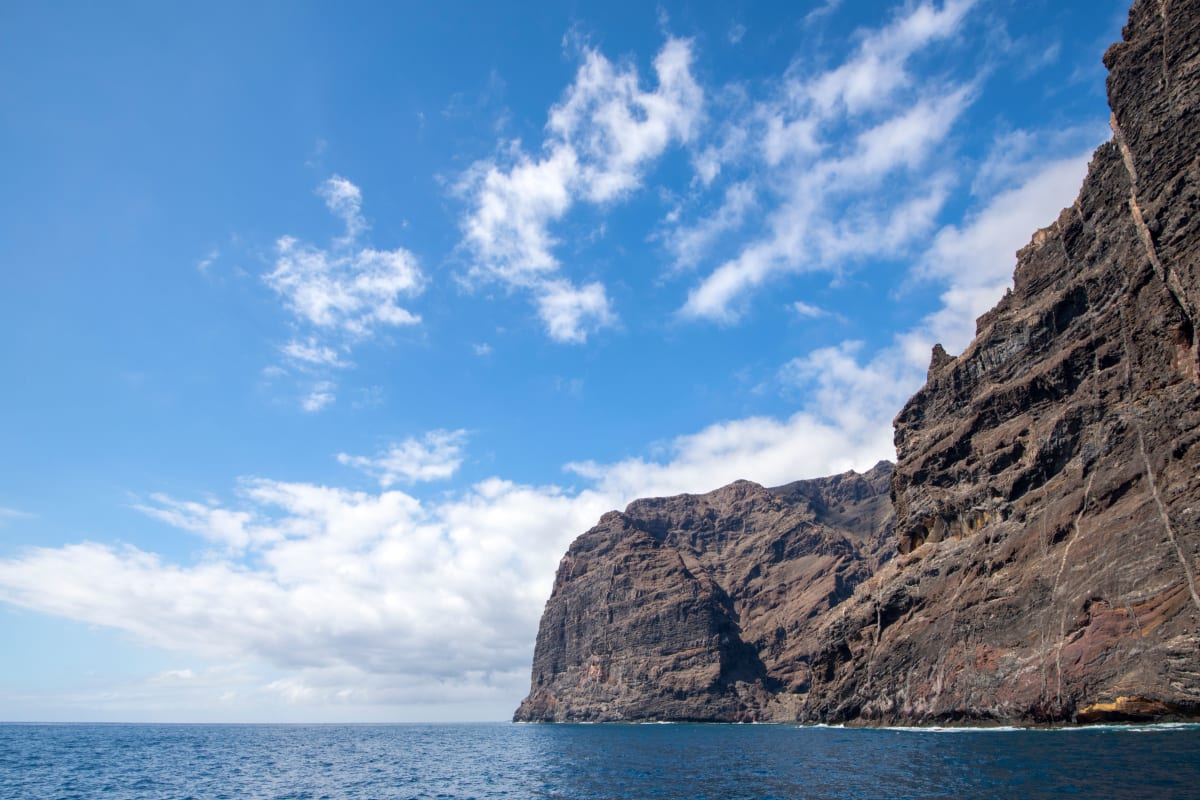
Los Gigantes is the smallest and the most scenic. Boats leave directly under the cliffs, which fall five hundred metres straight into the sea, so the journey out is a sight in itself before any animal appears.
Which boat to choose
The choice is between three types and the right one depends on who is with you.
A catamaran is stable, wide and shaded, with room to move about. It is the family option and the option for anyone unsure about their stomach.
A sailing yacht is quieter and closer to the experience of being at sea rather than on an excursion. Smaller groups, less shade, more sensitive to swell.
A speedboat covers more water and reaches the animals faster. It is also wet, hard on the back and unsuitable for small children.
Timing
Morning trips are calmer. The wind on this coast builds through the day, and a sea that is glassy at nine is choppy by three. Sightings are also easier to spot on flat water.
Sightings do not have a season here, which is the point of a resident population. Migratory species pass through, and between spring and autumn there is a chance of sperm whales, fin whales and orcas, but nobody should book expecting one.
What you are likely to see
Short-finned pilot whales are the resident species and the ones almost every trip finds. They are large dark dolphins rather than whales in the popular sense, travelling in family groups that stay together for life, and they spend long periods resting at the surface, which is what makes them so reliably visible here.
Bottlenose dolphins are the other residents. They are the ones that come to the boat, ride the pressure wave off the bow and jump, and they are the reason most people go home happy.
Atlantic spotted dolphins appear in large fast groups, more often in summer.
Beyond those four, everything is a bonus. Sperm whales pass through in spring and autumn, and orcas and fin whales are recorded every year without being predictable. Around twenty-eight cetacean species have been logged in these waters, roughly a third of all the species known, which is why the channel between Tenerife and La Gomera carries European protection as a Special Area of Conservation.
Two hours or five
The choice of trip length changes what you are buying more than the choice of operator does.
A two-hour trip goes out, finds the resident pilot whales, watches them, and comes back. That is the wildlife, and for a lot of people it is all they want. It is the cheapest option and it works with small children whose patience is finite.
A four or five-hour trip adds a run along the coast, usually west towards Los Gigantes, an anchored swim stop in a sheltered bay, and lunch aboard. The wildlife content is the same. What you are paying the extra for is the day on the water, which is a perfectly good thing to buy as long as you know that is what it is.
The one to avoid is the very cheap two-hour trip on an overloaded boat that leaves at the same time as four others. Sightings are shared and the rules cap how many vessels may be present, so the boats queue, and the time you actually spend with animals shrinks accordingly. Departure times spread through the day are a better sign than a low price.
Booking, and when
Trips run every day of the year and sell out in the school holidays and over Christmas and New Year, which is high season here rather than low. Outside those weeks a day or two ahead is enough.
Book the morning slot if there is a choice. Cancellations for weather are rare on this coast but they happen, and a morning trip cancelled can often be moved to the afternoon, while an afternoon trip cancelled is a lost day.
Watching from the land
It is possible, and it is free, and almost nobody mentions it. The cliffs above Los Gigantes and the headland at Punta de Teno both overlook water the pods use, and on a calm day with binoculars pilot whales are visible from the shore.
It is not a substitute for a boat and it will not produce photographs. It is a good thing to do with an hour and a pair of binoculars, and it costs nothing.
The rules the boats work under
Spanish law sets the distances and the Canary Islands enforce them. Vessels must not approach within sixty metres of a cetacean, must not cut across a pod's path, must not stay longer than thirty minutes, and no more than three boats may be in the same area at once. Feeding, touching and swimming with them is prohibited outright.
Enforcement is real and the fines are large. A boat that breaks the rules with you aboard is risking its licence, which is worth remembering if a skipper is being pushed by passengers to go closer.
The sixty-metre rule also explains something that disappoints people. On a boat behaving correctly the animals are further away than the photographs on the booking page suggest. Those photographs were taken with a long lens, or by animals choosing to approach, which they often do, and which is the only legal way to be close to them.
What to take, and what to take beforehand
Sun protection is the main thing. There is no shade on open water, the reflection doubles the exposure, and people who spent a careful week under a parasol get badly caught on a boat.
Take something for seasickness before you leave the harbour rather than when you start to feel it. Even a calm day here has an Atlantic swell running under it.
A light layer is worth having. Once a boat is moving the apparent wind is cold even in August.
The part nobody puts in a brochure
You will probably see pilot whales. You will probably not get the photograph you had in mind. They surface to breathe, show a dorsal fin and a stretch of back, and go down again, and they do it for six to eight minutes at a time.
Dolphins are the ones that put on a show, riding the bow wave and jumping. If your expectation is built on a documentary, adjust it before you board: what you are getting is a genuine encounter with wild animals in their own water, which is better than a performance and looks nothing like one.